Fish Network Whitepaper
Version 1.0 | December 15th, 2025
Executive Summary
Fish Network is reimagining early-stage capital formation by replacing inefficient centralized crowdfunding portals with decentralized Fish Schools - community-driven investment clubs that combine expert curation with collective decision-making, all powered by blockchain infrastructure.
As communities scale, governance and diligence become the bottleneck. Fish AI Agents convert passive investors into active contributors by compressing diligence time, organizing discussions, and enabling voice-confirmed voting—improving decision quality while keeping the system squarely within the parameters of an SEC recognized investment club.
The Problem
Traditional crowdfunding platforms charge excessive fees (up to 10% of assets under management), suffer from adverse selection as high-quality companies avoid them, and offer investors little liquidity or transparency. Meanwhile, venture capital remains concentrated among a small number of firms, limiting access for both investors and founders.
Our Solution
Fish Network enables investors to form thesis-driven communities called Fish Schools - legally compliant investment clubs where capital is pooled upfront, startups compete for funding through community votes, and transparency is enforced through smart contracts on Coinbase's Base Layer 2 blockchain.
Agentic AI Layer
Fish Network includes an agentic AI layer that reduces participation friction while preserving investment-club requirements for active member involvement. Voice and chat-based assistants help members review opportunities, ask questions, and cast consent-based votes; social distribution agents help Fish School Organizers communicate thesis, updates, and due diligence to existing communities without general solicitation. The AI layer is designed to increase informed participation—not replace individual decision-making.
Key Innovation
Unlike traditional syndicate models where investors commit per deal, Fish Schools operate with pre-funded capital pools. This eliminates deal-by-deal friction, ensures serious commitment, and allows organizers to move quickly when opportunities arise. This provides investors with a more capital efficient deployment mechanism, that can help facilitate any type of social capital formation use case.
Market Opportunity
With over $5 billion in USDC on the Base network alone, Fish Network targets just 1% market penetration to achieve $100 million in Total Value Locked. As the billion-dollar small team era accelerates, efficient capital formation infrastructure becomes critical for both founders and investors.
Vision
Today, Fish Network provides the comprehensive framework for emerging managers to scale US based community-driven venture capital. Tomorrow, Fish Network will become the global operating system for democratized early-stage investing, designed for the average retail investor. By providing a different set of tradeoffs between collaboration, optionality, and diversification, Fish Network provides global access to US private markets using transparent and compliant on-chain systems, coupled with existing custody and identity verification solutions.
Table of Contents
- Introduction
- The Broken State of Crowdfunding
- Fish Network Solution
- Technical Architecture
- Economic Model
- Legal & Compliance Framework
- Platform Participants
- Fish Points: Reputation & Rewards
- Anti-Money Laundering (AML) & Know Your Customer (KYC) Compliance Framework
- How and Why Fish Network will win
- Conclusion
1. Introduction
1.1 The Billion-Dollar Small Team Era
Over the past decade, technology has enabled increasingly small teams to build billion-dollar companies. What once required hundreds of employees and years of infrastructure buildout can now be accomplished by fewer than a dozen founders and operators, leveraging AI, cloud computing, and blockchain technology.
This shift creates both opportunity and challenge:
Opportunity: More founders can build transformative companies with less capital
Challenge: Traditional venture capital and fundraising infrastructure wasn't designed for this velocity
1.2 The Capital Formation Gap
Despite technological progress, the infrastructure for matching capital with innovation remains antiquated:
- Venture Capital: Highly concentrated, with top-tier firms receiving thousands of applications for limited spots
- Crowdfunding Portals: Burdened by high fees, poor match quality, and limited liquidity
- Angel Networks: Fragmented, relationship-dependent, and geographically constrained
Fish Network bridges this gap by creating scalable, transparent, and community-driven investment infrastructure built for the modern era.
1.3 Total Addressable Market
By 2030, the majority of illiquid assets will be tokenized and traded on-chain. A major trend is the "democratization" of private markets, which makes these assets more accessible to individual investors through traditional structures like Reg CF Funding Portals and Alternative Trading Systems(ATS), and new structures like private market decentralized exchanges(DEXs) that enable peer-to-peer transactions between primary transactions(issuers and investors) and secondary(investor to investor) transactions.
Alternative Investments Market:
- Global alternative investments: $13.7 trillion AUM (2024)
- Private equity: $5.8 trillion
- Venture capital: $1.1 trillion
- Target: <1% of VC market = $11 billion TAM
Crowdfunding Market:
- U.S. equity crowdfunding: $1.5 billion raised in 2024
- Compound annual growth rate: 16% (2020-2024)
- Reg CF limit increase to $5M (2021) drove significant growth
- Fish Network positioned to capture majority of future growth
Crypto Capital Formation:
- $19.6 billion raised via crypto VC deals in 2024
- Base L2 ecosystem: $10+ billion TVL
- Target: 1% of Base USDC = $100 million TVL
- Expanding to other L2s and chains over time
2. The Broken State of Crowdfunding
2.1 Platform Economics Are Misaligned
Traditional equity crowdfunding platforms operate on a pay-to-list model, charging startups upfront fees plus ongoing compliance costs that can reach 10% of assets under management. This creates adverse selection: high-quality companies avoid these platforms, leaving lower-signal deals to dominate supply.
Result: Investors lose trust, participation drops, and the entire ecosystem stagnates.
2.2 Investor Experience Is Poor
Current crowdfunding platforms offer investors:
- Limited transparency into deal quality and due diligence processes
- Uncertain liquidity with 7-10 year lockup periods and no secondary markets
- High friction in decision-making, requiring commitment before seeing the full opportunity set
- No community alignment or collective wisdom in investment decisions
2.3 Founders Face Structural Disadvantages
Startups seeking capital through existing platforms encounter:
- High costs that dilute their runway before they even begin building
- Adverse selection stigma from appearing on platforms known for lower-quality deals
- Slow processes that can take months to close even small rounds
- Limited value-add beyond capital, with no engaged community support
2.4 Why Hasn't This Been Fixed?
Traditional platforms are constrained by:
- Technology limitations - paper-based processes that don't scale
- Regulatory complexity - compliance frameworks built for analog era
- Business model incentives - revenue tied to transaction fees, not outcomes
- Network effects - no single platform has achieved sufficient liquidity
Fish Network addresses each of these constraints through blockchain infrastructure, modern compliance frameworks, and aligned incentive structures.
3. Fish Network Solution
Fish Network introduces a dual-entity and dual token model to facilitate investor community engagement and social interaction. Fish Schools pool capital together and use Erc-20 functionality to track pro-rata ownership over investments. Fish Shoals do not pool capital for investment, but instead use Erc-721M functionality to monetize and/or gate-access to investments while providing additional social coordination benefits for its members.
3.1 Core Innovation: Fish Schools
A Fish School is a community-driven investment club structured as a Series LLC, where:
- Capital is pooled upfront by investors who share an investment thesis
- Expert organizers curate and vet deal flow in their domain of expertise
- Community members vote on which startups receive funding
- Smart contracts enforce transparency, automate distributions, and track reputation
- Legal compliance is built-in through proper entity structure and regulatory adherence
3.2 How Fish Schools Work
Capital Allocation Model — “80/20 Micro-Fund” (points + front-loaded admin fees)
Use Cases: Investment clubs and private funds as Fish Schools; capital is raised prior to deployment.
- Best for: early pilots, fast launches, low complexity
- ≥80% deployed to investments
- ≤20% for admin/ops and early execution costs (front-loaded)
Formation Phase:
- Vetted Fish School Organizer creates a new school with specific investment thesis (e.g., "DeFi Infrastructure on Base" or "AI-Powered Consumer Apps")
- Organizer establishes Series LLC entity with proper legal documentation
- Investment parameters are set: minimum/maximum school size, investment criteria, governance rules
Funding Phase:
- Fish School Organizers undergo KYC/KYB through trusted 3rd party gateway
- Capital contributions are made in USDC
- Funds flow to qualified custody (Coinbase Prime/SFOX) for security
- Smart contracts on Base L2 manage escrow and routing
Investment Phase:
- Organizer sources and vets startup opportunities
- Qualified startups pitch to Fish School community
- Members review materials, ask questions, conduct diligence
- Community votes onchain using earned Fish Points for governance weight
- Winning startups receive immediate capital deployment
Distribution + Portfolio Support Phase:
- Portfolio companies achieve liquidity events (acquisition, IPO, secondary sales)
- Proceeds flow back through smart contracts
- Automated distribution to Fish School members proportional to ownership
- Fish reputation points as rewards for successful picks, building member reputation
Future Use Case: Rolling "funds" as investment clubs; fundraising "seasons" or "campaigns" which will enable multiple fund closing periods, similiar to a traditional VC fund.
Future Enhancement: Quadratic voting and/or equity-weighted voting
Future Liquidity: Ability to opt-in to Liquidity Premium via governance vote
3.3 Fish School Fee Structure
No Pay-to-List: Unlike traditional crowdfunding platforms, Fish Network does not charge startups upfront listing fees. This ensures high-quality deal flow and removes adverse selection.
Platform Economics:
For Fish Schools (Organizers):
- 0% formation fee to create a new Fish School
- Fish Reputation Points are accrued
- Fish must vote and collectively agree on any at-cost compensation for Organizers
- Adminstrative SaaS fees are paid monthly to Fish Network by the Fish School
For Fish Network (Platform):
- 1% platform fee on capital deployed to startups
- 0.5% secondary market fee on liquidity transactions (future)
- 1-3% withdrawal fee(future) based on lockup period
- Premium features for enterprise Fish Shoal (analytics, white-label, API access)
For Investors:
- No subscription fees to join Fish Schools
- No performance fees paid to Fish Network or Organizers(instead, Organizers participate directly in the upside alongside investors in each Fish School)
- Adminstrative fees are paid pro-rata by all investors
- Ability to opt-in to Liquidity Premium for optional early liquidity
- Gas fees only for on-chain transactions (minimal on Base L2)
3.4 Key Differentiators for Fish Schools
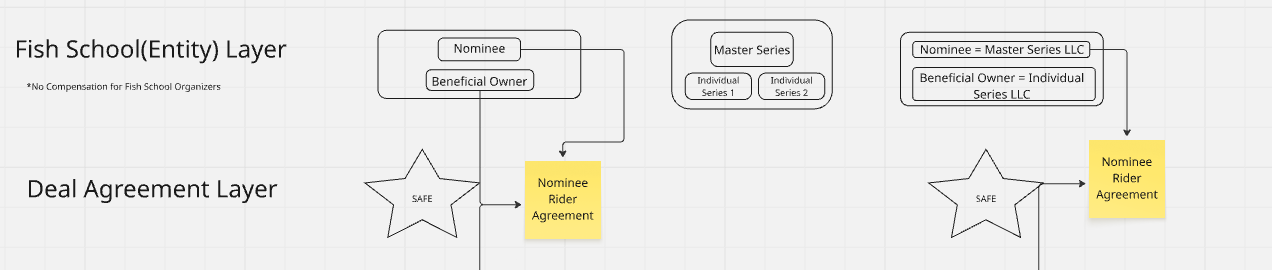
Instead of CrowdSAFEs, which strip investors of voting rights (similar to traditional SPVs), Fish Network introduces a nominee structure to streamline admin, and a nominee delegate(typically an individual) to simplify accountability, distribute workload, and give power to the "fish."
Furthermore, Fish Network provides its Fish Schools with a built-in Nominee Rider side letter, to provide more governance protections to the Fish, such as information and pro-rata rights.
| Traditional Crowdfunding Platform | Fish Network |
|---|---|
| Pay-to-list fees (~10%) | No listing fees |
| One-off commitment per deal | Pre-funded capital pools |
| Limited transparency | Fully onchain voting & distributions |
| 7-10 year illiquidity | Semi-liquid with redemption windows |
| Platform curates deals | Community curates deals |
| Traditional VC | Fish Network |
|---|---|
| Concentrated ownership | Distributed from day one |
| $100K+ minimum checks | $100+ minimum investment |
| Requires warm introductions | Open application process |
| GP makes all decisions | Community governance |
| Limited fund sizes | Unlimited scaling potential |
| Syndicate Model | Fish Network |
|---|---|
| Deal-by-deal fundraising | Pre-funded pools |
| Uncertain close amounts | Known capital availability |
| High deal friction | Rapid deployment |
| Antiquated structures with carried interest | Legally compliant investment clubs |
| Leader carries all risk | Distributed decision-making |
3.5 Fish Shoals
Fish Shoals represent a conglomerate of different communities that have mutuals interests. A Fish Shoal is a non-capital pooling community-driven investment club structured as a Series LLC, where:
- Access is gated or monetized by NFTs or traditional SaaS by investors who share an investment sector interest
- Members can propose, curate and vet deal flow in their domain of expertise
- Community members vote on which members should receive Organizer status
- Members can choose to invest directly or pool capital through a traditional SPV
- Smart contracts prove membership, enforce compensation transparency, and automate payment distributions
- Members can provide services(including deal sharing) to startups in exchange for compensation
- Shoal Leads may represent B2B entities that manage or administer multiple Fish Schools
3.6 The Fish Network Flywheel
Legal compliance is built-in through proper entity structure and regulatory adherence.
- Businesses create Fish Shoals to leverage community to increase reach and impact
- Shoals help appoint Fish School Organizers who create Fish Schools focused on specific theses or sectors
- Investors join schools aligned with their interests and expertise
- Startups compete for capital by pitching to relevant Fish Schools and/or Shoals
- Community votes to fund the best opportunities quickly
- Successful investments create returns and reputation (Fish Points)
- Top performers attract more capital and better deal flow
- Network effects strengthen as ecosystem grows
This creates a virtuous cycle where quality begets quality, and the platform becomes increasingly valuable to all participants.
4. Technical Architecture
4.1 Blockchain Infrastructure
Fish Network is built on Coinbase's Base Layer 2, an Ethereum-compatible blockchain optimized for consumer applications. Base provides:
- Low transaction costs for frequent voting and governance actions
- High throughput to support thousands of concurrent Fish Schools
- EVM compatibility enabling integration with DeFi ecosystem
- Coinbase integration for seamless fiat onramps and custody
4.2 Smart Contract Architecture
Core Contracts:
FishSchool.sol - Master contract for each investment club
- Manages member registry and permissions
- Tracks capital contributions and ownership percentages
- Enforces governance rules and voting mechanisms
- In the future liquidity model, routes capital according to a 50/40/10 split
- Handles distributions from liquidity events
FishEscrow.sol - Secure capital custody during evaluation period
- Holds 50% of contributions in 21-day escrow window
- Accrues Fish Points for depositors during lock period
- Releases capital to voted startups after community decision
- Implements emergency pause and recovery functions
FishPoints.sol - Reputation and governance token
- ERC-20 compatible but non-transferable (soulbound)
- Earned through capital contribution, voting participation, and successful picks
- Used for governance weight in investment decisions
- Tracks onchain reputation and contribution history
FishGovernance.sol - Voting and proposal management
- Creates investment proposals for startup funding
- Manages voting periods and quorum requirements
- Weights votes by Fish Points holdings
- Executes approved proposals automatically
- Records all votes onchain for transparency
FishRegistry.sol - Platform-wide coordination
- Maintains list of all active Fish Schools
- Tracks organizer credentials and reputation
- Enforces platform-wide parameters and limits
- Enables cross-school analytics and reporting
- Manages protocol fees and treasury
FishAgentRouter (Optional Module / Interface Layer)
- A standardized interface for AI-assisted workflows (summaries, consent-hash logging, vote execution requests)
- The router enforces that only KYC-attested wallets can submit binding actions and can require consent-hash proofs prior to vote execution
4.3 Custody & Security
Qualified Custody: All investor funds are held in qualified custody through Slash, Coinbase Prime or SFOX institutional services, ensuring:
- Institutional-grade security
- Regulatory compliance for investment advisors
- Insurance coverage for digital assets
- Segregated accounts per Fish School
- Audit trails for all movements
Smart Contract Security:
- Contracts follow OpenZeppelin standards
- Multi-signature controls on critical functions
- Time-locks on parameter changes
- Emergency pause mechanisms
- Regular security audits by third-party firms
4.4 Identity & Compliance Infrastructure
Fish Network leverages market leading identity and compliance on-chain solutions to perform direct KYC/AML checks on each Fish School Organizer prior to capital deployment. Fish Network also provides tools on platform to enable Fish School Organizers to KYC its members.
Compliance automation features included:
- Onchain attestations - Verified credentials stored as soulbound tokens
- Privacy-preserving - Minimal data exposure while maintaining compliance
- Automated accredited investor verification
- Real-time transaction monitoring for suspicious activity
- Automated reporting for SEC Form C filings
- Cap table management and ownership tracking
- Tax document generation (K-1s, 1099s)
Third Party Integrations:
- cb.id - Coinbase's on-chain identity system for investors
- SFOX verification - Institutional-grade KYB for Fish School entities
- KYC/KYB/AML provider: Simplici
4.5 Interoperability & Extensibility
Fish Network smart contracts are designed for composability:
- ERC-4626 tokenized vaults for Fish School shares (future enhancement)
- Integration hooks for DeFi protocols (lending, derivatives)
- Oracle support for off-chain data (startup valuations, liquidity events)
- Cross-chain messaging for multi-chain expansion
- Open APIs for third-party tools and analytics
4.6 Agentic AI Layer
Fish Network provides an agentic AI system (“Fish Agents”) that supports investors, organizers, and startups across the full lifecycle of a Fish School. Fish Agents reduce the overhead of participating in governance and diligence while ensuring that final actions—especially votes and binding decisions—remain attributable to individually verified members.
Fish Agent Types
- Voting Agent (Voice + Chat): Guides verified members through proposals, confirms intent, and executes on-chain voting transactions only after explicit user consent and wallet signature.
- Diligence Q&A Agent: Operates as a structured question-and-answer layer for each startup and proposal, indexing uploaded materials (pitch deck, data room summaries, legal docs, traction metrics) and producing verifiable citations to source documents.
- Community Discussion Agent: Moderates and summarizes school discussions, surfaces unanswered diligence questions, identifies consensus points and disagreement areas, and generates daily/weekly “governance briefings” for members.
- Organizer Social Agent: Generates compliant communications for Fish School Organizers (FSOs) to distribute thesis updates, calls-to-action (e.g., “vote by Friday”), and post-investment reporting to their existing community channels.
- Startup Update Agent: Helps portfolio startups draft structured investor updates (monthly metrics, milestones, risks, asks) and routes questions back to founders in an organized queue.
Consent, Identity, and Auditability: All agentic interactions that result in governance or capital-routing actions require:
- Verified identity (KYC/KYB),
- An explicit user confirmation step (voice or text), and
- A cryptographic signature by the user’s wallet. The system may store a hash of the consent transcript and link it to the corresponding on-chain transaction for auditability.
Compliance-First Design: Fish Agents are designed to increase active participation by reducing friction (reading time, coordination cost, execution complexity). They do not remove responsibility from individual members and do not autonomously manage pooled assets.
5. Future Economic System of Engineered Liquidity
5.1 Liquidity in Private Markets
Fish Network introduces a comprehensive, multi-faceted, and phased go-to-market approach to introduce liquidity in traditional assets for retail investors. By sharing and borrowing liquidity across schools, Fish Network is able to introduce distinct tradeoffs, giving individual investors more control and choice over their investment decisions. Without Fish Network, these liquidity options or tradeoffs would otherwise be impossible or impractical at the individual asset or issuer level.
FUTURE MODEL: — “50/40/10 Split” (escrow + tokenized investment club equity)
- 50% → FishLP Contract: Smart contract escrow earning stablecoin yield; comprehensive liquidity for all fish schools
- 40% → Escrow: Distributed to winning startup(s) based on community vote
- earning Fish Points during 21-day evaluation window
- 10% → Fish School treasury for operations, legal, and administration
Tradeoff: Enables 1:1 withdrawal functionality, but more capital is tied up in stablecoins.
Liquidity: Shared liquidity layer enables early redemptions; minimum lockup period is 3 weeks up to 1 year(subject to fees/lockups per school).
Synthetic Exposure + Active Governance: Tokenized investment club equity provides diversified exposure to US assets for international investors; may also provide the investor other protective covenants such as tag-along, voting, or information rights.
*Liquidity in Private Markets will be available to non-US residents only
5.2 Capital Flow
Investor Contribution → Fish School:
- Investor commits USDC to join Fish School
- Funds flow to qualified custody (Coinbase/SFOX)
- Smart contract records ownership and mints Fish Points
- Capital enters 21-day evaluation/escrow period
Fish School → Startup Investment:
- Community votes to allocate capital to winning startup(s)
- 40% of school capital deployed automatically via smart contract
- Startup receives investment in USDC
- Fish School receives equity stake (tokenized or traditional cap table entry)
Startup → Liquidity Event → Distribution:
- Portfolio company achieves exit (acquisition, IPO, secondary sale)
- Proceeds converted to USDC and returned to Fish School smart contract
- Automatic pro-rata distribution to all Fish School members
- Organizer receives performance-based compensation from treasury
- Successful voters earn bonus Fish Points for picking winners
5.3 Liquidity Mechanisms
Fish Network is designed to provide semi-liquid exposure to fundamentally illiquid venture assets through structured liquidity coordination, rather than promising continuous liquidity. Liquidity is explicitly priced, gated, and governed to preserve capital integrity while improving flexibility relative to traditional venture funds and syndicates.
5.3.1 Primary Liquidity — Redemption Windows
Fish Schools may offer liquidity through scheduled redemption windows, subject to disclosed school-specific terms.
Standard Characteristics:
- Redemption cadence: Periodic (e.g., monthly or quarterly), as defined by each Fish School
- Minimum notice period: Typically three (3) weeks
- Lockups: Some Fish Schools may impose extended lockups of up to one (1) year, disclosed prior to contribution
- NAV reference: Redemptions are processed based on the most recent portfolio valuation methodology adopted by the school
Redemptions are honored only during designated windows and may be limited or deferred to preserve fairness across members and avoid forced asset sales.
5.3.2 Shared Liquidity Layer — Network Coordination
Fish Network coordinates liquidity across multiple Fish Schools through a shared liquidity layer, designed to smooth redemption demand and reduce idiosyncratic liquidity risk at the individual school level.
Key Properties:
- Liquidity is coordinated, not guaranteed
- Redemptions may be satisfied through cross-school matching, reserve capital, or structured netting mechanisms
- Shared liquidity improves capital efficiency without requiring immediate liquidation of underlying portfolio assets
This approach allows Fish Network to provide earlier or partial liquidity in some cases while preserving long-term upside for remaining participants.
5.3.3 Liquidity Premium — Explicit Pricing of Liquidity (Default: 5%)
To bootstrap and maintain shared liquidity, Fish Network may apply a Liquidity Premium to capital contributions.
Definition:
The Liquidity Premium is a refundable percentage of contributed capital (default 5%) allocated to a protocol-level liquidity contract (the FishLP Contract).
Purpose:
- Build and grow Total Value Locked (TVL) at the network level
- Support redemption coordination without forced asset sales
- Explicitly price liquidity access rather than socializing liquidity risk implicitly
- Create a durable liquidity backstop benefiting all Fish Schools over time
Mechanics:
- The Liquidity Premium is deducted at contribution
- Premium capital is routed automatically, on-chain, into the FishLP Contract
- Capital in the FishLP Contract is subject to longer lockups and protocol-level governance
- Liquidity Premium capital does not represent ownership in any single Fish School portfolio
Applicability:
- The Liquidity Premium may apply to all Fish Schools by default
- The premium may be mandatory or increased for:
- Fish Schools launched off-platform
- Fish Schools operating outside the United States
- Fish Schools opting into enhanced or accelerated liquidity features
Liquidity Premium rates may be adjusted over time based on network conditions, and are disclosed prior to contribution. In the future, Fish Schools will be able to opt-in(via a governance vote) to activate their previously locked "Liquidity Premium" to facilitate early liquidity for investors.
5.3.4 Liquidity Haircuts — Network Resilience Mechanism (Future / Conditional)
In addition to the Liquidity Premium, Fish Network reserves the right to apply Liquidity Haircuts under specific circumstances.
Definition:
A Liquidity Haircut is a non-refundable one-time allocation of capital (anticipated range: 5%–20%) from Fish Schools to the FishLP Contract to reinforce shared liquidity.
Potential Triggers:
- Network-wide liquidity stress events
- Introduction of new shared liquidity mechanisms or redemption facilities
- Major protocol upgrades or economic transitions
- Regulatory or jurisdictional changes requiring additional liquidity buffers
Characteristics:
- Liquidity Haircuts are not routine fees
- Any haircut would be:
- Applied uniformly or by disclosed class of Fish Schools
- Executed transparently via on-chain routing
- Allocated to shared liquidity rather than platform revenue
This mechanism is disclosed in advance to preserve long-term flexibility and avoid retroactive economic changes.
5.3.5 Liquidity Tradeoffs and User Expectations
Fish Network does not promise continuous liquidity. Instead, it provides structured optionality with clear tradeoffs:
- Liquidity access may reduce deployable capital to individual Fish Schools
- Earlier liquidity may be subject to discounts, premiums, or haircuts
- Long-term participants benefit from shared liquidity growth and network effects
By pricing liquidity explicitly and coordinating it at the network level, Fish Network aims to deliver a more flexible and resilient alternative to traditional venture lockups—without misrepresenting the inherently illiquid nature of early-stage investments.
5.4 Value Capture & Sustainability
Network Effects:
- More Fish Schools → more deal flow → better opportunities → more investors
- More investors → more capital → better terms → more startups
- More successful exits → more reputation (Fish Points) → higher quality participants
Future Monetization Paths:
- Transaction fees on capital deployment (1% baseline)
- Management fees on platform treasury and services (2% annual)
- Premium services for Fish Shoals and Schools (analytics, marketing, legal templates)
- Data licensing (anonymized deal flow and performance metrics)
- Secondary market fees when liquidity mechanisms launch
Long-term Sustainability: Platform is designed to be capital-efficient and self-sustaining through fees that align with user success rather than extractive rent-seeking.
Fish Network brings targeted advantages for angel investors and emerging managers through compliant, tokenized crowdfunding and AI-driven deal matching. This positions Fish Network to capture significant share in VC, equity crowdfunding, and crypto ecosystems.
6. Legal & Compliance Framework
6.1 Entity Structure
Customers will form a Master Series LLC on platform owned by their existing entity. If the customer is an individual, they will be prompted to form a holding company(optional), which can be leveraged as a "GP Stakes" management entity, or a minimum viable venture studio.
Fish Network provides flexibility in structuring to accomodate a broad set of use cases for compliant on-chain capital formation. Fish Schools are currently Member-Managed LLCs with a Nominee Delegate(defined below).
Upon approval of an investment proposal, the platform executes the investment using a nominee-based structure that mimics a traditional CrowdSAFE instrument, but Instead gives investors actual equity with voting rights, amongst other protections upon a trigger event that warrants conversion into traditional equity shares(typically common stock).
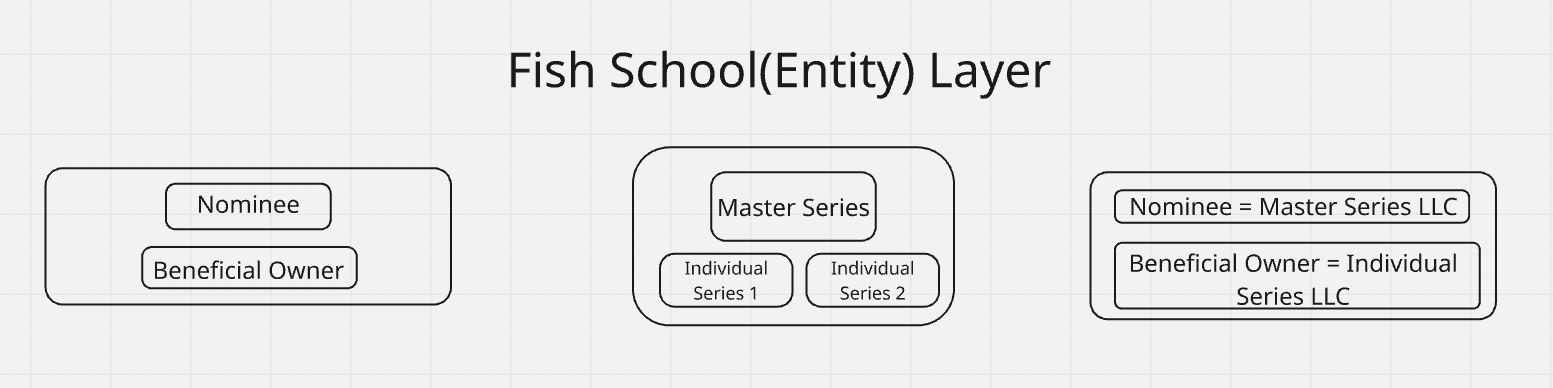
- Nominee: A Fish School LLC(typically the Master, but can be the individual Series) that holds legal title to the investment on behalf of all Fish Schools and their respective members.
- Beneficial Owners: Individual Fish School Series LLC retains beneficial ownership interests.
- Nominee Delegate: An individual, typically the Fish School Organizer or Deal Champion, authorized to execute administrative, contractual, and issuer-facing actions on behalf of the Nominee.
- Required to represent the majority voting interest of its Fish School members
The Nominee Delegate is obligated to:
- broadcast governance proposals and voting outcomes to Fish School members, and
- execute investment decisions in accordance with the majority vote of the Fish School, as determined through reputation-weighted on-chain governance.
This structure simplifies administrative execution while preserving investor voting rights and accountability, distinguishing the system from traditional SPVs and CrowdSAFE-based structures that centralize control.
Each Fish School operates as a Series LLC with the following characteristics:
- Limited Liability: Protects members from personal liability beyond their investment
- Series Structure: Each Fish School is legally separate from others and the platform
- Pass-through Taxation: Avoids double taxation; members report on personal returns
- Investment Club Model: Collective decision-making avoids GP/advisor regulations
Each Fish School has the following set of Organizational Documents:
1) Required: Operating Agreement defining governance, basic voting parameters, and profit distributions
- Optional: Bylaws establishing custom voting procedures and company specific decision rules
2) Required: Membership Admission Agreement for new member onboarding
3) Recommended: Investment Policy Statement outlining thesis and criteria for investments
Future Enhancement: Fish Network will also offer Nominee-Managed Fish Schools, which are designed specifically for the needs of Emerging Managers.
The Nominee's role is to execute investments pursuant to pre-approved mandate. The Nominee acts as fiduciary executor, but has no authority outside the agreed upon mandate.
This structure has the following three benefits when compared to a member-managed LLC.
- Cleaner external representation
- Faster execution
- Simplifies reporting
6.2 Securities Regulation Compliance
Fish Schools may be regulated as an investment club or a private fund.
6.2.1: Investment Clubs
Fish Schools are capital-pooling member-managed Investment Clubs. They are generally unregulated by the SEC as long as they maintain the below characteristics throughout the lifecycle of operation.
- No Passive Members
- Fish Network: All members must vote over both governance and investment decisions or they risk involuntary termination and/or reputation penalties
- No General Solicitation
- Fish Network: Investment Clubs do not have a public facing website; instead they create a Fish School on Fish Network platform and bring their existing social capital.
- No Management Fees or Carried Interest
- Fish Network: Fish vote and approve any administrative expenses, including Fish School Organizer compensation. Any compensation is valued at-cost, and does not imply fiduciary duty.
- No Promotion or Endorsement of Securities
- Fish Network: Fish School Organizers only promote their thesis and are not compensated by issuers; deals are chosen post-funding.
- Must have 99 members or less
- Fish Network: Fish School smart contracts are limited to a 99 member maximum.
Investment and Member Limits: Varies State by State in the USA. Non-accredited investors are allowed.
6.2.2: Regulation Crowdfunding (Reg CF):
A Fish Shoal is a non-capital pooling investment club that allow issuers to raise capital directly from non-accredited investors under SEC Regulation Crowdfunding, enabling:
- $1.07 million maximum per 12-month period per Issuer(not subject to audit)
- $5 million maximum per 12-month period per Issuer(subject to audit)
- Accredited investors have no investment limits
- Form C filing with SEC before offering begins
- Ongoing reporting requirements (annual financials, material changes)
- Non-accredited investors can participate subject to investment limits
- If annual income or net worth < $124,000: Greater of $2,500 or 5% of lesser amount
- If annual income and net worth ≥ $124,000: 10% of lesser amount, up to $124,000
6.2.3 : Regulation D:
- Nominee-led Fish Schools are private funds exempt from SEC registration under section 3c1 of the Investment Act of 1940.
- Form D filed shortly after first sale
- No General Solicitation under Rule 506b
7. Platform Participants
7.1 Fish (Investors)
Who They Are:
- Individuals seeking exposure to early-stage venture investments
- Accredited and non-accredited investors (subject to Reg CF limits)
- Crypto-native users comfortable with onchain transactions
- Traditional investors seeking alternative assets
What They Do:
- Browse and join Fish Schools aligned with their investment interests
- Contribute USDC capital to selected Fish Schools
- Participate in community due diligence and discussions
- Vote on startup funding decisions
- Earn Fish Points for participation and successful picks
- Receive distributions from portfolio liquidity events
- Use voice and chat-based Fish Agents to:
- receive proposal summaries and diligence briefs,
- ask questions and receive structured answers,
- cast consent-based votes with reduced on-chain friction, and
- stay engaged via automated reminders and governance briefings.
Value Proposition:
- Access to curated deal flow previously available only to VCs
- Diversification across multiple startups and sectors
- Community-driven due diligence and decision-making
- Semi-liquid investment exposure vs. traditional 10-year lockups
- Transparent onchain record of all transactions and votes
- Build reputation (Fish Points) for investment acumen
7.2 Fish School Organizers
Who They Are:
- Emerging fund managers looking to build track records
- Domain experts in specific sectors (DeFi, AI, consumer, etc.)
- Former operators or founders with strong networks
- Community leaders with engaged followings
- Experienced angels looking to scale their impact
What They Do:
- Create and manage thesis-driven Fish Schools
- Source and vet startup opportunities in their domain and present them to Fish for voting
- Facilitate community due diligence and voting processes
- Coordinate legal, compliance, and administrative functions
- Manage relationships with portfolio companies
- Orchestrate distributions and liquidity events
- Use Organizer Social Agents to draft and schedule compliant communications to existing communities (thesis updates, meeting recaps, vote reminders).
- Use Diligence Q&A Agents to consolidate due diligence, reduce repetitive Q&A, and maintain a consistent record of investor questions and founder responses.
Value Proposition:
- Build professional track record for future endeavors
- Access capital without traditional LP fundraising burden
- Leverage community for diligence and decision-making
- Reduce operational overhead through platform infrastructure
- Earn reputation points and administrative fees when agreed upon
- Scale influence beyond personal capital constraints
Requirements:
- Pass platform vetting process demonstrating expertise
- Commit to ongoing education and best practices
- Maintain transparency and communication standards
- Comply with all platform policies and regulations
7.3 Shoal Leaders (Multi-School Managers)
Fish Network plans to retain additional verticals(such as Real Estate, Art, and others) in-house by initially structuring them as the first Fish Shoals on the platform. Additional Shoals will be offered to B2B partners and early customers launching Fish Schools.
Who They Are:
- VCs or investment firms running multiple Fish Schools
- Ecosystem builders (e.g., Base ecosystem fund)
- Corporate venture arms experimenting with community models
- Accelerators integrating Fish Schools for their cohorts
- Registered Broker-Dealers providing on-chain capital formation services to clients
What They Do:
- Recruit and coach Fish School Organizers
- Provide shared services: deal flow, legal, operations, marketing
- Ensure quality standards across their managed Fish Schools
- Aggregate capital and relationships for ecosystem impact
- Run funnel-wide programs benefiting all schools
Capital Value Proposition:
- Activate community capital beyond traditional fund structure
- Create feeder system for larger funds
- Test emerging managers at low cost and reduced risk
Growth + Services Value Proposition:
- Monetize via SaaS or NFTs
- Build ecosystem presence and deal flow
- Membership limit increase: More than 99 members allowed
- Foster a services ecosystem to provide value-add to startups beyond capital
- Empower individual consultants to scale
7.4 Startups (Capital Seekers)
Who They Are:
- Primarily Base ecosystem builders initially
- Early-stage companies (pre-seed, seed, Series A)
- Companies seeking mission-aligned capital and community
- Founders who value transparency and fairness
What They Do:
- Apply to pitch relevant Fish Schools
- Present investment opportunity to community
- Answer questions and provide due diligence materials
- Receive funding if community votes in favor
- Provide ongoing updates to Fish School members
- Facilitate liquidity events and distributions
Value Proposition:
- No upfront listing or platform fees
- Access to pre-funded capital pools (faster closing)
- Fair evaluation based on merit, not relationships
- Community of engaged supporters beyond just capital
- Transparent process with clear timelines
- Potential syndication across multiple Fish Schools
8. Fish Points: Reputation & Rewards
8.1 Design Principles
Fish Points serve as a reputation and governance token designed to:
- Reward participation - Incentivize active engagement in Fish Schools
- Weight governance - Give more influence to proven contributors
- Build reputation - Create portable onchain track record
- Align incentives - Encourage quality over quantity in decision-making
- Enable meritocracy - Let performance speak louder than capital size
Key Characteristics:
- Non-transferable (Soulbound): Cannot be bought, sold, or transferred
- Earned, not purchased: Acquired only through platform participation
- Onchain and verifiable: Transparent history of all accruals
- Cross-school portable: Reputation follows user across Fish Schools
- Decaying over time: Encourages ongoing participation vs. resting on laurels
8.2 How Fish Points Are Earned
Capital Contribution:
- Base accrual rate: 1 Fish Point per $1 contributed to Fish School escrow
- Accrued during 21-day escrow period before capital deploys
- Lockup bonus: Additional points for longer commitment periods
- Early supporter bonus: Extra points for joining new Fish Schools
Voting Participation:
- 10 Fish Points per vote cast on investment decisions
- Bonus for detailed feedback and due diligence contributions
- Streak bonuses for consistent voting participation
- Quality bonus if vote aligns with majority (reduces gaming)
Successful Picks:
- 100 Fish Points when portfolio company achieves positive exit (>2x return)
- 250 Fish Points for exceptional exits (>5x return)
- Proportional to ownership and investment performance
- Distributed at liquidity event, not mark-to-market
Community Contributions:
- Sourcing winning deals: 200 Fish Points per successful referral
- Quality due diligence: Up to 50 Fish Points for detailed analysis
- Mentoring startups: Points for value-add beyond capital
- Platform improvements: Rewards for bug reports, feature suggestions
8.3 Fish Points Utility
Governance Weight:
- Voting power in Fish School decisions weighted by Fish Points
- Prevents whale dominance (capital alone doesn't rule)
- Gives proven performers more influence
- Encourages long-term engagement
Access & Privileges:
- Tier 1 (0-1,000 points): Access to basic Fish Schools
- Tier 2 (1,000-10,000 points): Access to premium schools and early deal flow
- Tier 3 (10,000+ points): Eligibility to become Fish School Organizer
- Tier 4 (50,000+ points): Shoal Leader opportunities and platform governance
Reputation & Signaling:
- Public leaderboards showing top performers
- Onchain credential proving investment track record
- Portable reputation across DeFi and Web3
- Proof of sophistication for future opportunities
Future Utility (Roadmap):
- Discounts on platform fees for high Fish Points holders
- Priority access to oversubscribed Fish Schools
- Governance rights over Fish Network platform decisions
- Potential token conversion if Fish Network issues governance token
- AI-Assisted Participation:
Fish Points may be awarded for AI-assisted governance actions that still require individual consent. This reinforces active participation while reducing the friction of traditional governance workflows.
8.4 Anti-Gaming Mechanisms
Instead of using typical crypto staking mechanisms which invite manipulation, we avoid these problems by forcing all participants to vote; the majority must agree on the use of capital. Each member receives a governance stake proportional to the capital they invest in the fish school.
Sybil Resistance:
- KYC/KYB requirements prevent multiple identities
- Non-transferable design prevents Fish Points markets
- Capital contribution minimums prevent spam accounts
Quality Filters:
- Time delays between actions prevent rapid farming
- Decay mechanisms reduce inactive user balances
- Vote alignment bonuses reward thoughtful decisions
- Penalty for pattern of poor performance (consistent losses)
Economic Security:
- Fish Points have no monetary value and cannot be sold
- Governance decisions still require capital at risk
- Platform can adjust earning rates to maintain balance
- Emergency ability to reset or adjust gaming accounts
9. Anti-Money Laundering (AML) & Know Your Customer (KYC) Compliance Framework
9.1 Anti-Money Laundering (AML) & Know Your Customer (KYC)
Fish Network performs direct KYC/AML checks on each Fish School Organizer prior to capital deployment. Fish Network has implemented comprehensive AML/KYC procedures through a Customer Identification Program (CIP) including ongoing monitoring for all Fish School Organizers.
Fish Network provides tools on platform to enable Fish School Organizers to KYC their members. However, Fish School Organizers are responsible for enforcing their own individual KYC policies and ensuring compliance with applicable regulations for their specific Fish School.
Technology Partners: Compliance infrastructure provided through cb.id and other institutional services which reduces Fish Network's operational burden while maintaining regulatory standards.
9.2 Custody & Financial Regulations
Qualified Custody Rule:
To comply with SEC custody requirements for investment advisors:
- All investor funds held at qualified custodians (Coinbase Prime, SFOX)
- Independent verification of holdings
- Direct delivery of account statements to investors
- Surprise examinations by independent auditors
Smart Contract Limitations:
While smart contracts automate certain functions, they do not constitute custody. Actual digital assets remain with regulated custodians, and smart contracts serve as:
- Routing mechanisms for approved transactions
- Governance and voting infrastructure
- Record-keeping and transparency layer
9.3 Tax Considerations
Pass-Through Structure:
Fish Schools are structured as pass-through entities:
- No entity-level taxation on Fish Schools
- Members receive K-1 forms annually
- Capital gains, losses, and income flow through to member tax returns
- Each member's tax treatment depends on individual circumstances
Fish Points Tax Treatment:
Fish Points are designed as non-transferable reputation tokens:
- No immediate tax event upon receipt
- Not treated as income when earned
- May have tax implications if future liquidity is introduced
- Members should consult tax advisors for specific situations
Reporting:
Platform provides:
- Annual K-1 forms for Fish School members
- 1099 forms for certain distributions
- Transaction history for tax preparation
- Integration with crypto tax software (CoinTracker, TaxBit)
9.4 Risk Disclosures
All Fish School investors receive comprehensive risk disclosures:
- Loss of Capital: Venture investments are high-risk; total loss possible
- Illiquidity: Limited ability to exit investments before liquidity events
- Dilution: Portfolio companies may raise additional capital, diluting ownership
- Regulatory Changes: Evolving crypto and securities regulations may impact operations
- Smart Contract Risks: Technology risks including bugs, exploits, or failures
- Custody Risks: Despite qualified custodians, digital asset theft remains possible
- AI and Automation Risk: Fish Network’s AI-assisted interfaces may introduce risks including inaccurate summaries, misinterpretation of intent, or operational errors; therefore, binding actions require explicit user confirmation and wallet signatures, and users remain responsible for their decisions.
10. How and Why Fish Network will win
Fish Network navigates a fragmented competitive landscape by addressing the core weaknesses of traditional crowdfunding, syndicate platforms, and DAO tools through its unique combination of community governance, and compliant infrastructure. This positions Fish Network to outperform direct competitors while complementing indirect players like VC funds and public markets.
10.1 Go-to-Market Strategy
Fish Network's GTM strategy is focused on serving the needs of emerging managers and their respective retail investors in private markets, starting with venture capital. Instead of passively providing a software product, we actively educate, mentor, and guide emerging managers to structure and launch investment clubs through our proprietary Emerging Manager Program.
Phase 1: Base Ecosystem Focus + Emerging Manager Program (Months 1-12)
Target:
- 3 Emerging Manager cohorts successfully delivered
- 50 Fish Schools launched
- $10 million TVL
- 1,000+ active investors
- 100+ startups funded
Tactics:
- Emerging Manager education program
- Offer first 10 Fish School Organizers zero platform fees
- Build case studies with early success stories
- Partner deeply with Coinbase and Base team
- Recruit Base ecosystem VCs as Shoal Leaders
- Sponsor Base ecosystem events and hackathons
Phase 2: Multi-Chain Expansion (Months 13-24)
Target:
- 200 Fish Schools across multiple sectors
- $50 million TVL
- 10,000+ investors
- 500+ startups funded
Tactics:
- Launch on Arbitrum, Optimism, Polygon
- Expand beyond crypto to traditional tech startups
- Partner with accelerators (Y Combinator alumni, Techstars)
- Introduce fund-of-funds for institutional capital
- Build secondary market for Fish School shares
Phase 3: Platform Maturity (Months 25-36)
Target:
- 500+ Fish Schools globally
- $250 million+ TVL
- 50,000+ investors
- 2,000+ startups funded
Tactics:
- White-label solution for VCs and corporate venture arms
- International expansion (EU, APAC, LATAM)
- Tokenized shares and DeFi integrations
- Reg A+ support for larger raises ($5M-$75M)
- Adjacent asset classes (real estate, music, art)
Network Effects:
Must maintain Fish School Organizer quality to drive the investor and founder flywheel; exceptional emerging managers bring investors and great founders.
- Measuring Startup application quality
- Number of deals approved by Fish School Organizers
- Measuring Investor Referral rate
- Number of Investors earning points through referral
- Total # of points distributed because of referrals
- Measuring Cross-school collaboration and syndication
- Number of Fish Schools merged on platform
- Number of deals shared across Fish Schools
- Number of deals co-invested by 2 or more Fish Schools
10.2 Strategic Partnerships
Fish Network leverages strategic partnerships to amplify its market reach and distribution into new ecosystems. Furthermore, we also leverage partnerships to offer platform participants access to value-add services that streamline or enhance the investment process for collaborative investing.
Current Infrastructure Partners:
- Coinbase / Base: Blockchain, custody, identity, onramps
- SFOX: Institutional custody and compliance services
- MetaLeX: Legal entity automation (BORGs/cyberCORPs)
- Fairmint: Equity tokenization for portfolio companies
Existing Service Provider Partners:
- PaperOS for entity formation and document templates and workflows
- Law firms: Customized legal docs and compliance to enable cross border deals
- Audit + Tax firms: Portfolio valuation and tax services
- Advisory firms + agencies: Fish School growth and branding, investor acquisition services
- Analytics platforms: Data and insights for organizers and fish
Potential Distribution Partners:
- Base Ecosystem Fund: Deal flow and co-investment
- Y Combinator: Access to alumni network
- Techstars: Accelerator integration
- A16z Crypto: Potential Shoal Leader and validator
10.3 Success Metrics - What does winning look like?
Fish Network quantifies success through a combination of traditional investment metrics and user engagement analytics(quantified through Fish Points).
Platform Health:
- $ Assets under Administration (AUA) by Fish Schools
- Number of active Fish Schools
- Number of Fish Schools actively raising capital
- Number of Fish Schools actively deploying capital
- Average Fish School Longevity
- Longevity defined as: # of months the fish school is raising + # of months deploying + # of months in portfolio support
- Measuring Customer Lifetime Value:
- % of customers that upgrade to higher SaaS tiers and/or purchase additional add-on services
User Engagement:
- % of customers who launch a second fish school
- Measuring number of active investors via monthly voting participation metrics
- Fish Points distribution and concentration
- Repeat investment rate across multiple schools
- Net Promoter Score (NPS) from all participants
Investment Performance:
-
Primary Metrics:
- IRR, MOIC, and DPI across Fish School portfolios
- Comparative performance vs. private market benchmark indices
-
Secondary Metrics:
- % of Fish Schools that return 1x capital to investors
- Number of successful liquidity events and $ amount of distributions
- % of startups with a subsequent success signal (ex. Series A raised, revenue milestones achieved)
10.4 Competitive Landscape
Fish Network stands out by unlocking standing capital and distributed decision-making across fragmented markets, turning the weaknesses of high-fee crowdfunding, lead-dependent syndicates, and non-compliant DAOs into opportunities for seamless, community-led investing.
Direct Competitors:
Traditional Crowdfunding Platforms:
- Examples: StartEngine, Republic, Wefunder, SeedInvest
- Weaknesses: High fees, poor UX, adverse selection
- Fish Network advantage: Pre-funded pools, community governance, no listing fees
Syndicate Platforms:
- Examples: AngelList, Assure, Alumni Ventures
- Weaknesses: Deal-by-deal friction, lead-dependent model
- Fish Network advantage: Standing capital, distributed decision-making
DAO Investment Platforms:
- Examples: Syndicate Protocol, Spring.net
- Weaknesses: Regulatory uncertainty, limited compliance infrastructure
- Fish Network advantage: Compliant entity structure, qualified custody
Indirect Competitors:
Traditional VC Funds:
- Examples: Andreessen Horowitz, Sequoia, Paradigm
- Weaknesses: Limited to US Accredited Investors; traditional LP structures give investors little control or rights.
- Fish Network advantage: complements by enabling emerging managers to serve non-accredited investor market segment
Public Markets:
- Examples: Robinhood, Coinbase retail trading
- Weaknesses: Onerous reporting requirements; investor focus on profitability instead of scaling innovative public goods
- Fish Network advantages: Leverage hybrid vehicles that mix private and public markets for diversification opportunities; ability to explore public market liquidity solutions for synthetic private market assets and/or portfolios.
11. Conclusion
11.1 The Opportunity
We stand at an inflection point. Technology has enabled smaller teams to achieve outsized outcomes, yet the infrastructure for matching capital with innovation remains rooted in analog processes, misaligned incentives, and unnecessary intermediaries.
Fish Network solves this by creating transparent, community-driven investment infrastructure built on blockchain rails. By pre-funding capital pools, distributing decision-making, and enforcing transparency through smart contracts, we eliminate the friction that has plagued both founders and investors.
11.2 Why Now
Three converging trends make Fish Network possible today:
- Regulatory Clarity: Reg CF and investment club structure provides a compliant path for community capital formation
- Potential for looming change in accreditation laws to streamline retail participation in private markets
- Infrastructure Maturity: Coinbase/SFOX and other partners offer institutional-grade custody and compliance.
- On-chain identity systems offer a significantly lower cost alternative to traditional KYC/KYB costs
- Market demand: $19.6B in crypto VC deals (2024) shows appetite for digital-native solutions.
- The Base L2 ecosystem alone represents $10+ billion in USDC liquidity seeking productive deployment. Capturing even 1% of this market creates a $100 million platform.
11.3 The Vision
Fish Network is building more than a crowdfunding platform. We're creating the operating system for democratized venture capital - infrastructure that will power community-driven investment for decades to come.
A world where:
- Anyone with capital can access world-class deal flow
- Anyone with expertise can build reputation to become a fund manager in the future
- Founders raise from aligned communities, not gatekeepers
- Transparency and fairness replace relationships and opacity
- Small teams building transformative companies find capital fast
11.4 Join Us
Whether you're an investor seeking access to high-quality ventures, a domain expert ready to launch your Fish School, or a founder looking for mission-aligned capital, Fish Network provides the infrastructure to participate in the future of venture capital.
The water's fine. Let's swim together.
Appendix A: Glossary
Base L2: Coinbase's Ethereum Layer 2 blockchain optimized for consumer applications.
Fish: Individual investor participating in Fish Schools.
FishLP Contract: Open smart contract that holds USDC; facilitates the shared liquidity layer across Fish Schools.
Fish Network: The platform enabling creation and operation of Fish Schools and Shoals.
Fish Points: Non-transferable reputation token earned through platform participation.
Fish School: Community-driven investment club structured as a Series LLC to pool investments together.
Fish School Organizer: Vetted expert managing a specific Fish School.
Fish Shoal: Non-capital pooling investment club that facilitates a shared community aggregation layer.
Reg CF: SEC Regulation Crowdfunding allowing up to $5M raises from retail non-accredited investors.
Series LLC: Legal structure where each "series" operates as a separate entity with liability protection.
Shoal Leader: B2B entity overseeing multiple Fish Schools with shared services.
USDC: USD Coin, dollar-pegged stablecoin used for all platform transactions.
Appendix B: Risk Factors
Investment Risks
Loss of Capital: All venture investments carry risk of total loss. Investors should only commit capital they can afford to lose.
Illiquidity: Despite redemption windows, Fish School investments are fundamentally illiquid and may not be readily convertible to cash.
Dilution: Portfolio companies may raise additional capital, diluting Fish School ownership stakes.
Valuation Uncertainty: Private company valuations are subjective and may not reflect fair market value.
Concentration Risk: Fish Schools focused on specific sectors may be heavily impacted by industry-specific downturns.
Technology Risks
Smart Contract Risk: Bugs or vulnerabilities in smart contracts could result in loss of funds despite audits.
Blockchain Risk: Base L2 or Ethereum network issues could disrupt platform operations.
Custody Risk: Despite qualified custodians, digital asset theft or loss remains possible.
Key Management: Loss of private keys could result in inability to access investments or voting rights.
Regulatory Risks
Regulatory Change: Securities laws and crypto regulations are evolving; future changes may impact operations.
Compliance Costs: Increased regulatory scrutiny could raise operational costs and reduce profitability.
Enforcement Actions: SEC or state regulators could bring enforcement actions affecting platform or Fish Schools.
Tax Treatment: Tax treatment of Fish Points and digital securities may change, creating unexpected liabilities.
Platform Risks
Adoption Risk: Platform may fail to achieve critical mass of users, limiting network effects.
Competition: Existing platforms or new entrants could capture market share.
Organizer Risk: Poor performance or misconduct by Fish School Organizers could damage reputation.
Technology Failure: Bugs, downtime, or security breaches could erode user trust.
Market Risks
Economic Downturn: Recession or market crash could reduce startup valuations and exit opportunities.
Crypto Market Volatility: Despite USDC stability, broader crypto market volatility may impact user confidence.
Startup Failure Rate: Venture-backed startups have high failure rates; most investments will not return capital.
Appendix C: Legal Disclaimers
This whitepaper is for informational purposes only and does not constitute:
- An offer or solicitation to sell securities
- Investment, legal, or tax advice
- A guarantee of returns or performance
All potential investors should:
- Conduct independent due diligence
- Consult qualified legal and financial advisors
- Review all offering documents before investing
- Understand risks including total loss of capital
Fish Network and Fish Schools are only available to eligible investors in compliance with securities laws. Nothing in this whitepaper should be construed as a recommendation to participate.
Past performance does not guarantee future results. All projections are forward-looking statements subject to risks and uncertainties.
Document Version: 1.0 Last Updated: December 24, 2025 Contact: legal@fishnetwork.co Website: www.fishnetwork.co Join Fish Network: https://beta.fishnetwork.xyz Documentation: docs.fishnetwork.co
© 2026 Fish Network. All Rights Reserved.