Fish Network Value Proposition

Fish Network, through blockchain & AI-enabled software infrastructure, offers investors new mechanisms to achieve superior returns by taking a community driven & systematic approach to coordinating humans and capital.
We apply this principle across all aspects of the investing lifecycle; from sourcing and diligence, to reputation management and decision making efforts.
The Diligence Constraint Facing Modern Fund Managers
Private market investing is ultimately a human judgment business. Whether capital is deployed by angel investors, solo GPs, emerging managers, or established venture firms, the quality of outcomes depends on underwriting discipline. Yet even the most experienced fund managers operate under structural constraints.
Top-tier VCs see thousands of opportunities per year. Emerging managers must move quickly to build track records. Institutional funds manage multiple portfolio companies simultaneously. No individual partner—no matter how capable—can deeply diligence every deal at institutional quality. Time is finite. Cognitive bandwidth is finite. Sector expertise is unevenly distributed.
As a result, many fund managers rely on:
- Internal delegation to associates and principals
- Social proof from other brand-name investors
- Pattern recognition rather than full-scope validation
- Prior relationships as proxies for diligence
Limited partners face a similar challenge. LPs underwriting venture funds often cannot fully evaluate each underlying portfolio company. They instead underwrite the manager profile: background, prior firm, brand affiliation, or narrative coherence.
In both cases, capital frequently follows reputation rather than collectively verified insight.
Diligence is expensive. It is time-intensive. It is difficult to monetize directly. And it is rarely distributed efficiently across qualified participants.
Pooling Diligence Across Manager Profiles
In traditional structures, diligence is siloed within a firm. Emerging managers must build internal capacity from scratch. Solo GPs operate with limited analytical bandwidth. Associates contribute insight but often lack visibility.
Fish Network enables diligence to be distributed across qualified participants within and across Schools. Sector specialists, operators, legal analysts, and financial modelers can contribute structured analysis that is recorded and reputationally weighted.
This approach aligns with the principles demonstrated in The Wisdom of Crowds, where structured aggregation of informed participants can outperform isolated experts. It also reflects Linus Torvalds’ observation—often referred to as Linus’s Law—that “given enough eyeballs, all bugs are shallow.” In private markets, more qualified review increases the likelihood that hidden risks are surfaced before capital is deployed.
For fund managers, this reduces blind spots.
For LPs, this reduces reliance on brand alone.
For emerging investors, this creates a pathway to build measurable credibility.
More importantly, diligence costs are pooled. Instead of one partner spending 60 hours underwriting a deal, analysis can be modularized across domain experts. Managers preserve time for portfolio construction and founder support while maintaining deeper underwriting coverage.
Time saved becomes strategic leverage. Shared judgement beats hype when it is structured and coordinated across the spectrum of human capital.
Diligence is one of the structural gaps Fish Network addresses.
From Star Managers to Structured Collaboration
Traditional venture capital is organized around individual manager profiles. The industry emphasizes:
- The “star partner”
- The proven brand
- The charismatic emerging manager
- The former operator with strong domain expertise
While talent clearly matters, this model concentrates judgment in a small number of individuals. Attribution is often opaque; junior investors contribute materially but are tracked subjectively. High-performing partners frequently reach internal ceilings and eventually spin out to raise independent funds.
This creates two inefficiencies:
- Manager Concentration Risk – Capital outcomes are tied heavily to a small number of decision-makers.
- Talent Leakage – Strong performers leave established firms to pursue autonomy, fragmenting institutional knowledge.
Fish Network restructures collaboration to address both.
Fish Schools: Independent P&Ls Within a Coordinated Framework
A Fish School is a legally instantiated capital coordination unit with:
- Its own segregated treasury
- Embedded compliance and custody
- Tokenized membership
- Independent P&L tracking
- Transparent contribution records
This structure combined with Fish Shoals unlocks a multi-manager dynamic inside private market asset allocation.
Instead of a single managing partner informally overseeing multiple junior investors, capital can be allocated top-down to distinct Fish Schools led by Fish School Organizers. Each School operates with autonomy while maintaining structural compliance and reporting consistency.
This mirrors the multi-manager hedge fund approach, where independent portfolio managers run segregated books under a unified risk mitigation framework.
Fish Network applies this framework to venture capital and other alternative asset classes. Each School becomes a measurable investing cell. Each Shoal coordinates multiple Schools towards a unified, fund-like investment outcome for LPs.
A New Profile for Fund Managers
Fish Network changes how manager profiles are evaluated.
Rather than relying primarily on:
- Prior firm affiliation
- Brand association
- Narrative credibility
- Manager's self-defined track record that is impractical to verify
Managers can be evaluated through:
- Independent P&L history
- Documented diligence contributions
- Risk detection quality
- Deal attribution transparency
- Performance across cycles
Junior investors inside established firms can operate Fish Schools to build verifiable track records without immediately leaving to raise standalone funds. Established VCs can allocate capital to Schools based on measured performance rather than intuition alone.
This enables firms to:
- Retain top performers
- Scale capital to high-signal investors
- Reduce internal political friction
- Make data-driven human capital decisions
Diversification extends beyond portfolio companies to investing talent itself.
From Reputation-Driven to System-Driven Capital Allocation
Private markets have historically centered on manager reputation. Fish Network shifts emphasis toward system-level intelligence.
Capital no longer depends solely on individual charisma or brand halo. It flows toward demonstrated performance, structured collaboration, and measurable judgment.
In this model:
- Funds become modular capital systems.
- Managers become operators of independent P&Ls.
- Diligence becomes a shared asset.
- Talent becomes quantifiable.
Collaboration is not a social feature layered onto finance. It is the inherent mechanism through which capital is deployed more intelligently. In Fish Network, this systematic collaboration becomes capital architecture for corporates and individuals alike.
When properly structured, shared intelligence compounds over time, creating the opportunity for both individuals and groups to create, share, and capitalize on alpha in the private markets.
Diversification
Diversification best practices in private markets are well understood, but poorly implemented in the market today. Game theory applied to Venture Capital suggests that an investor needs exposure to 100+ deals to be sufficiently diversified. As an institutional investor in a Fund of Funds, this becomes possible. However, it comes with a significant drawback; multiple layers of fees. Conversely, angel investing represents the opposite approach; to live and die by your own sword.
Below we explore the spectrum between these two extremes, examining the distinct economic and qualitative tradeoffs being made by the astute investor in private markets. We examine the opportunity costs associated with different behaviours as it relates to the investment process itself.
Fish Network Compared to Alternative Investing Approaches
| Feature | Traditional VC Funds | Solo Direct Investing | Fish School | Syndicate Model |
|---|---|---|---|---|
| Decision Control | Low | High | Medium | Medium-High |
| Diversification | High | None | Variable & Flexible | None |
| Deal Flow Access | High | None | Medium | Limited |
Furthermore, as a capital constrained angel investor, there is no feasible way to achieve these recommended levels of diversification. For the average investor, the only viable option today is to invest directly into a syndicate with a $5k or $10k check and pay 20% carried interest. This means you are writing a very small number of annual checks which doesn't bring you any closer to your diversification goals.
It's clearly rather difficult for the average retail investor to achieve sufficiently diversified exposure to private markets. As a result, most investors who can't afford to invest in blind pooled funds, leave private markets out of their portfolio entirely.
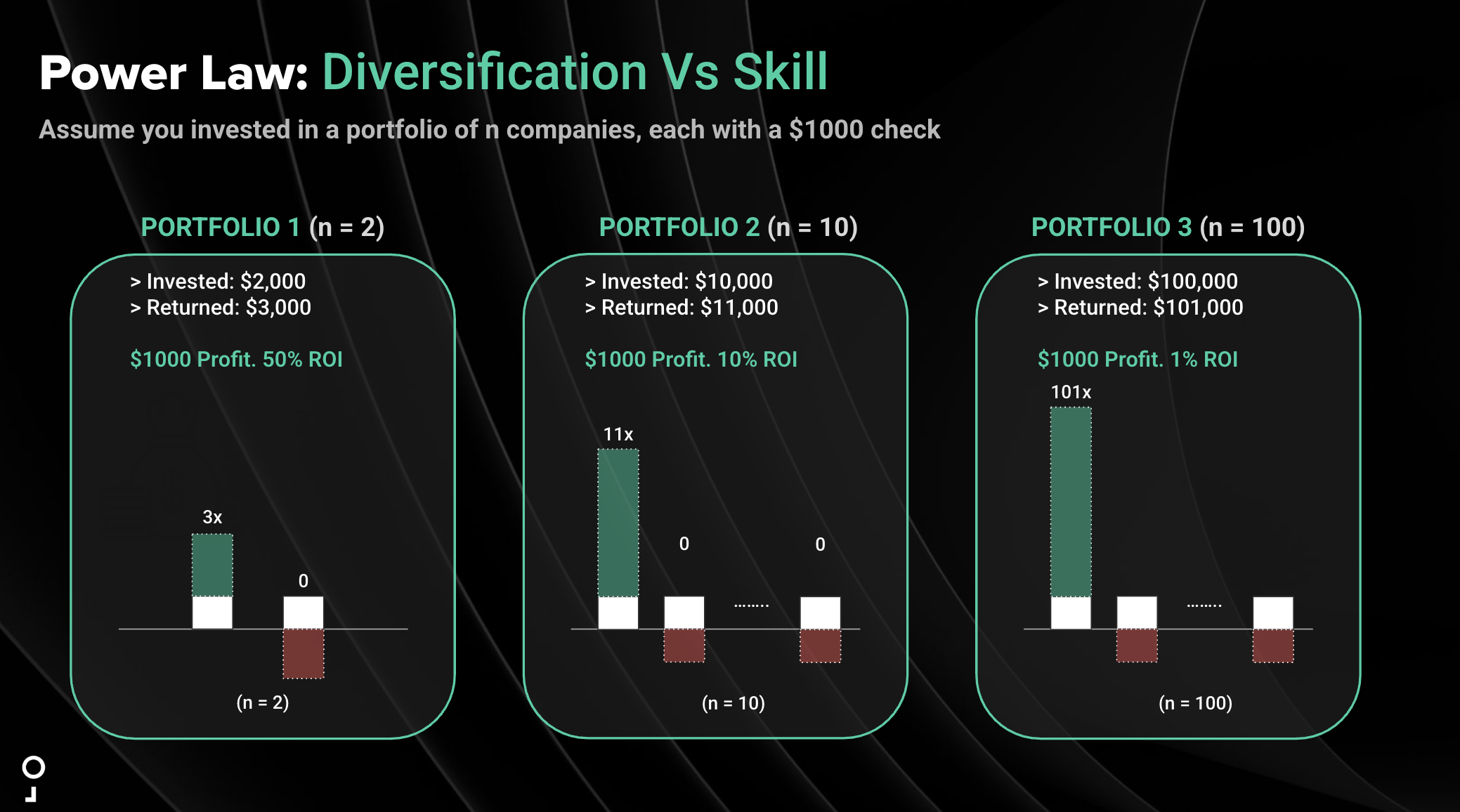
The Power Law implies that you need to make multiple bets in order for the math to work in your favor. This naturally increases diversification levels through exposure to multiple companies, while also reducing idiosynratic risk.
Fish Schools act as "micro portfolios" for domain experts to invest together. This enables a more scalable mechanism for investors to receive sufficient diversification in private markets, without one individual bearing the entire burden of diligence and sourcing upfront or the full responsibility of sheparding the company to exit down the road. Instead, investors work together to save time and money, while naturally improving their own individual diversification breadth across private investments.
Furthermore, investors can mitigate market timing risk by leveraging Fish Schools to dollar cost average(DCA) into private markets over a defined period of time(i.e. the deployment period).
Time and Cost Efficiency for Managers and LPs
Traditional SPVs and fund structures incur repeated overhead per transaction:
- Legal formation
- Subscription processing
- Compliance verification
- Administrative coordination
- Jurisdictional tax differences
- Accounting and distribution management
Costs scale more efficiently when you can amortize these costs over time, and across individual deals, through shared programmable infrastructure. Compliance is embedded. Custody is native. Distributions are deterministic.
The next time you decide to form an SPV and pay $10k+ in admin fees - pause.
The next time you decide to participate in an SPV, pay carried interest, and concede future voting rights - pause.
Then, create an account on Fish Network.
Optionality that Builds Investor Confidence
Fish Network gives investor ecosystems and emerging managers the collaborative toolkit institutions have long monopolized, enabling shared due diligence, pooled capital, and diversified exposure without million-dollar minimums or decade-long lockups.
Unlike direct investing, which demands full conviction and high deployment minimums, or funds locking capital for 7-10 years with limited control, Fish Schools let investors participate together across multiple deals with smaller individual check sizes. This creates portfolio-level optionality: choose schools by sector (ex. AI, biotech), stage (ex. pre-seed), and risk profile. This gives investors more alternative exit pathways, through secondary auction markets today, and structured optional liquidity via redemption windows in the future.
In this model:
- Deal selection: Vote on opportunities collectively rather than betting blindly on single companies
- Capital deployment: Deploy into multiple deals at once via Fish Schools, with the option to invest directly
- Time horizon: Shorter deployment cycles than funds with pre-defined exit criteria.
- Manager diversity: Back emerging GPs through schools rather than picking one "star" manager
- Geography & access: Global deal flow without relocation or network limitations
Fish Schools create unmatched flexibility:
- Select schools by thesis, risk tolerance, or Fish School Organizer reputation.
- Scale positions dynamically using real-time performance data
- Clear pathways for systematic exit via milestone triggers, or human-led secondary market auctions
- Build track record collaboratively, not individually
Collaboration as a Competitive Advantage
For established VCs, Fish Network offers:
- A mechanism to evaluate talent through independent School P&Ls
- Optionality in allocating capital across internal and external managers
- A structured way to retain and scale high performers
- Diversification across distinct judgment profiles
For emerging managers, it offers:
- A path to build track record without immediate fund formation
- Access to shared diligence resources
- Lower operational overhead
- Transparent capital coordination
For LPs, it offers:
- Diversification across multiple Schools
- Reduced key-person risk
- Visibility into decision-making processes
- Measurable attribution rather than narrative reporting
Collaboration mechanics become shared infrastructure that drives returns, not just marketing language to convince LPs to invest.
Through superior diversification tactics, structured optionality, and more cost efficient infrastructure, Fish Network enables the solo capitalist to scale, without being bogged down in ops, diligence, or compliance.
If you're a syndicate lead looking for an edge or a pivot, or an angel investor tired of paying carry, drop us a line today at fish@fishnetwork.co. Happy fishing!